Instrumentals
This is website will give you a whole knew look on musical instruments.
You will be able to expand you thinking to new levels and heights!!
Learn more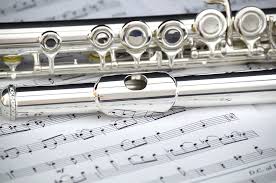

Flutes
The flute is a family of musical instruments in the woodwind group. Unlike woodwind instruments with reeds, a flute is an aerophone or reedless wind instrument that produces its sound from the flow of air across an opening. According to the instrument classification of Hornbostel–Sachs, flutes are categorized as edge-blown aerophones. A musician who plays the flute is called a flautist or flutist. Flutes are the earliest known identifiable musical instruments, as paleolithic examples with hand-bored holes have been found. A number of flutes dating to about 43,000 to 35,000 years ago have been found in the Swabian Jura region of present-day Germany. These flutes demonstrate that a developed musical tradition existed from the earliest period of modern human presence in Europe. While the oldest flutes currently known were found in Europe, Asia, too, has a long history with the instrument that has continued into the present day. In China, a playable bone flute was discovered, dated approximately 9000 years old. The Americas also had an ancient flute culture, with instruments found in Caral, Peru, dating back 5000 years and in Labrador dating back approximately 7500 years.
Violins
The violin, sometimes known as a fiddle, is a wooden chordophone (string instrument) in the violin family. Most violins have a hollow wooden body. It is the smallest and thus highest-pitched instrument (soprano) in the family in regular use. The violin typically has four strings, (some can have five), usually tuned in perfect fifths with notes G3, D4, A4, E5, and is most commonly played by drawing a bow across its strings. It can also be played by plucking the strings with the fingers (pizzicato) and, in specialized cases, by striking the strings with the wooden side of the bow (col legno). Violins are important instruments in a wide variety of musical genres. They are most prominent in the Western classical tradition, both in ensembles (from chamber music to orchestras) and as solo instruments. Violins are also important in many varieties of folk music, including country music, bluegrass music, and in jazz. Electric violins with solid bodies and piezoelectric pickups are used in some forms of rock music and jazz fusion, with the pickups plugged into instrument amplifiers and speakers to produce sound. The violin has come to be incorporated in many non-Western music cultures, including Indian music and Iranian music. The name fiddle is often used regardless of the type of music played on it.
Bongos
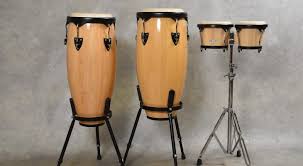
Bongos (Spanish: bongó) are an Afro-Cuban percussion instrument consisting of a pair of small open bottomed hand drums of different sizes. They are struck with both hands, most commonly in an eight-stroke pattern called martillo (hammer). They are mainly employed in the rhythm section of son cubano and salsa ensembles, often alongside other drums such as the larger congas and the stick-struck timbales. Bongo drummers (bongoseros) emerged as the only drummers of son cubano ensembles in eastern Cuba toward the end of the 19th century. The instrument remained important as son groups evolved into larger conjuntos and orchestras in Havana in the 1940s, at which point they began to share the stage with congas. Bongos later reached the United States, where they are commonly played in salsa, Afro-Cuban jazz, Latin rock and other genres.